Edward R. Murrow, RIAS Berlin, Voice of America, and the Sound of the Cold War (1961)
A Christmas Broadcast, American Policy, and the Moral Role of Radio
The Main Recording: Murrow Introduces a Christmas Broadcast from Divided Europe
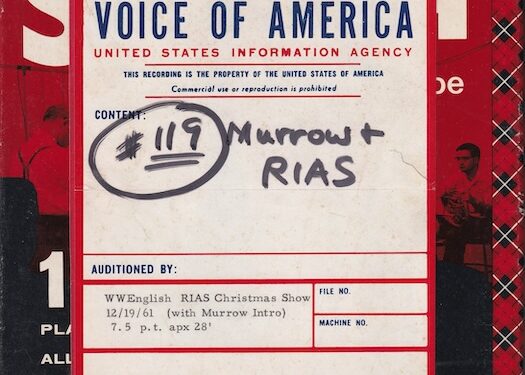
The principal recording presented here opens with Edward R. Murrow’s introduction to a Voice of America Christmas program broadcast on December 19, 1961, only months after the construction of the Berlin Wall. The program includes English-language spoken segments produced by RIAS Berlin, the American-supported radio station broadcasting from West Berlin to East Germany.
Murrow’s introduction is calm, restrained, and purposeful. He frames the program not as entertainment and not as crude propaganda, but as a human response to enforced division of Europe—a reminder that words, music, and memory could still cross borders closed by barbed wire and armed guards. Yet, the message in defense of human rights is strong and unmistakable.
For listeners in Eastern and Central Europe, including Poland, such broadcasts carried a meaning far beyond Christmas sentiment. They signaled that the West had not accepted the permanence of communist and Soviet domination.
RIAS Berlin
RIAS stood for Radio in the American Sector; German: Rundfunk im amerikanischen Sektor, a radio founded by the U.S. occupational authorities in 1946 that evolved into a surrogate home service for East German listeners. RIAS remained under U.S. oversight through the U.S. High Commission and later the United States Information Agency (USIA), which also administered the Voice of America since 1953, though at RIAS, day-to-day production was German-run. In this Voice of America English-language broadcast about RIAS, a U.S. Senator speaks directly to East German listeners, promising that “Americans have not forgotten you,” and listeners hear family greetings that can no longer cross the Wall. Together, these political and personal voices show why RIAS mattered in 1961 – and why this recording remains worth preserving today.
Who Was Edward R. Murrow?
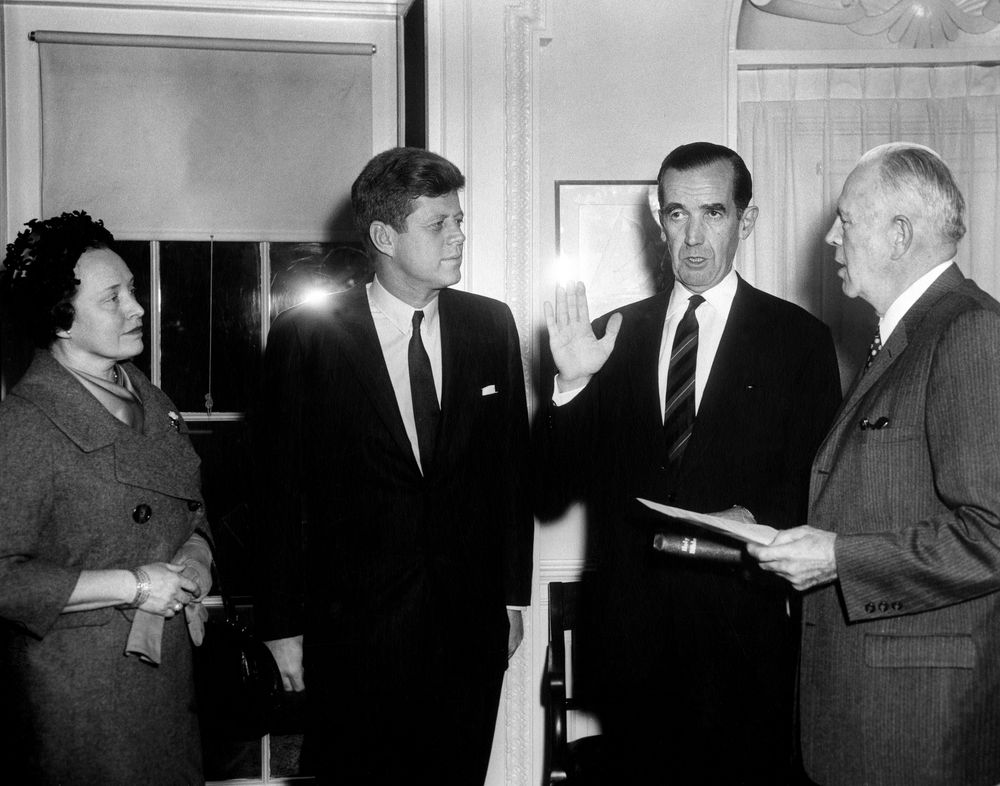
March 21, 1961. Swearing-in ceremony for Edward R. Murrow as Director of the United States Information Agency (USIA). White House Administrative Officer, Frank K. Sanderson, administers oath to Edward R. Murrow; President John F. Kennedy and Janet Brewster Murrow stand at left. Oval Office, White House, Washington, D.C. Abbie Rowe. White House Photographs. John F. Kennedy Presidential Library and Museum, Boston.
Edward R. Murrow was one of the most influential journalists of the twentieth century. During World War II, he became famous as a CBS correspondent in London, reporting on the Blitz and Nazi Germany. After the war, he entered government service and, in 1961, became Director of the U.S. Information Agency under President John F. Kennedy.
Murrow consistently argued that truth mattered—but he also understood that truth did not exist in a political vacuum. When later attacked by Senator Joseph McCarthy, Murrow stated that he had reported accurately from London on the Katyn massacre of thousands of Polish officers and intellectual leaders by the Soviets, and that he maintained close contact with Polish and other Central European exiles during the war. Recordings of Murrow’s wartime broadcasts on Katyn and the Warsaw Uprising are still being sought by the Muzeum Radia Zimnej Wojny.
VOA, Katyn, and Soviet Influence During World War II
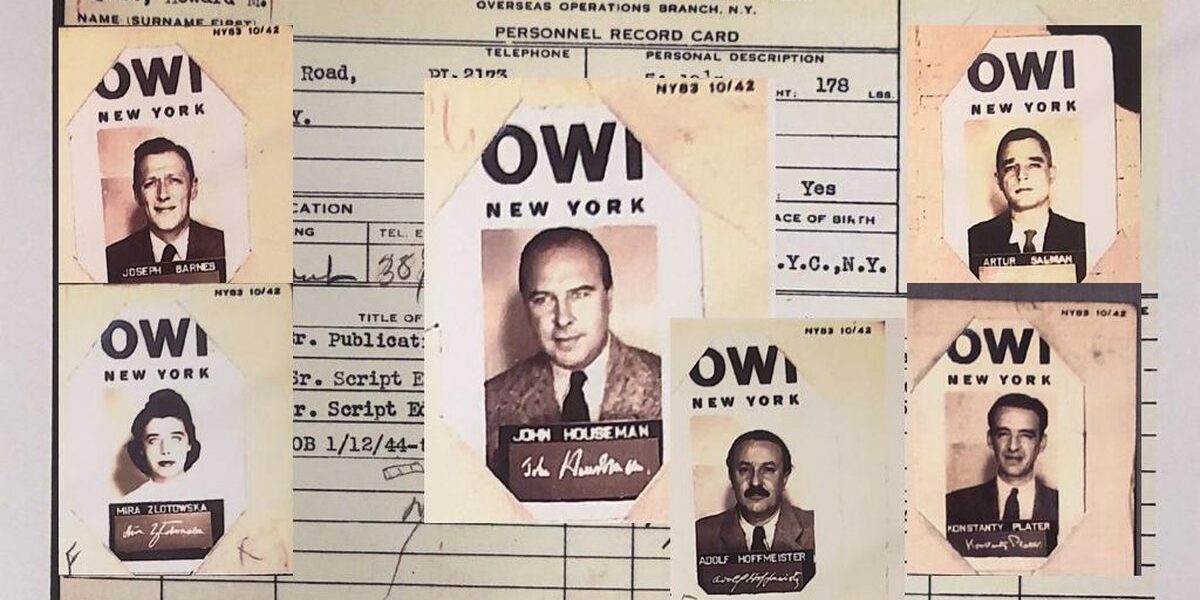
Figures associated with the Office of War Information and the Voice of America during World War II: John Houseman and Joseph Barnes (senior OWI/VOA officials); Howard Fast (chief VOA English news writer and editor, personnel card shown); several Polish Desk writers, editors, and broadcasters — Mira Złotowska, Arthur Salman( Stefan Arski), Konstanty Broel Plater — and Adolf Hoffmeister, VOA Czechoslovak Desk chief toward the end of WWII. Some of the broadcasters later worked for communist regimes. Howard Fast received the Stalin Peace Prize (1953). Polish Desk broadcaster Konstanty Borel Plater is the only known OWI employee to resign during the war in protest against Soviet propaganda in VOA programs. Believing himself to be bound by his U.S. government secrecy oath, he did not speak publicly about his protest until the early 2000s.
It is important to state clearly that many American and Western journalists—though not all—did accept or repeat Soviet propaganda during World War II, especially regarding Soviet crimes. The Katyn massacre was the most notorious case.
At the Voice of America, which operated during the war under the Office of War Information (OWI), the problem was not accidental or marginal. A number of VOA editors and officials accepted the Soviet claim that the Katyn massacre had been committed by Nazi Germany and actively suppressed or censored information pointing to Soviet responsibility. The institutional foundations of VOA itself were laid by Robert E. Sherwood, head of OWI’s Overseas Branch, and his deputy Joseph Barnes, with assistance from John Houseman, later celebrated as VOA’s “first director.” Houseman was not a journalist by training but a propagandist, best known as co-producer of the famous radio drama often cited as an early example of mass-media–induced panic.1 During the war, he recruited Communist Party members and individuals sympathetic to the Soviet Union into OWI broadcasting roles, and in 1943, the Roosevelt administration declined to issue him a passport for official government travel—an extraordinary step that reflected growing concern about his political judgment and associations.2
Professor Owen Lattimore, head of VOA broadcasts to Asia, accompanied Vice President Henry A. Wallace on his 1944 visit to Russia and later published in National Geographic a glowing description of the Kolyma gold mines — one of Stalin’s deadliest Gulag sites — claiming prisoners were “volunteer workers” for whom “extensive greenhouses growing tomatoes, cucumbers, and even melons” were built “to make sure that the hardy miners got enough vitamins!” [Exclamation in the original article.]3
At the VOA Polish Desk, editors such as Stefan Arski (Artur Salman) and Mira Złotowska (later Michałowska) were close to the chief writer and editor of the VOA English news program to Europe, Howard Fast, a novelist and communist sympathizer. He later joined the Communist Party USA and received the Stalin Peace Prize (1953). Mira Michałowska, who returned to Poland after the war and married a high-ranking diplomat of the Stalinist regime in Warsaw, translated some of Fast’s novels
In the VOA Polish Desk, editors such as Stefan Arski (Artur Salman) and Mira Złotowska (later Michałowska), were close to the chief writer and editor of VOA English news program, Howard Fast, who was a novelist and communist sympathizer. He later joined the Communist Party USA and received the Stalin Peace Prize (1953). Mira Michałowska, who returned to Poland after the war and married a high-ranking diplomat of the Stalinist regime in Warsaw, translated some of Fast’s novels into Polish for publication in Poland. He was also hailed and published in the Soviet Union.
Their role at the Voice of America during the war was part of a broader pattern in which wartime VOA output often reflected Roosevelt administration efforts to appease Stalin in order to preserve the alliance against Nazi Germany and carry out Roosevelt’s plans for post-war peace based on trust and close cooperation with Soviet Russia and agreeing to its hegemony over Eastern and Central Europe. In line with Soviet propaganda, Fast and Houseman were openly hostile toward the Polish Government-in-Exile in London, allied with the United States and Great Britain in the war against Nazi Germany. Fast censored criticism of the Soviet Union. OWI and VOA glorified Stalin as a supporter of freedom and democracy. In the words of one of OWI German Desk editors Julius Epstein—a Jewish refugee journalist from Austria, a distant relative of composer Johann Strauss II, briefly a member of the German Communist Party before breaking with it, and a highly regarded contributor to European newspapers and magazines—”the German desk was almost completely seized by extreme left-wingers who indulged in a purely and exaggerated pro-Stalinist propaganda.”4
Their role at the Voice of America during the war was part of a broader pattern in which wartime VOA output often reflected Roosevelt administration efforts to appease Stalin in order to preserve the alliance against Nazi Germany and carry out Roosevelt’s plans for post-war peace based on trust and close cooperation with Soviet Russia and agreeing to its hegemony over Eastern and Central Europe. Fast and Houseman were openly hostile toward the Polish Government-in-Exile in London allied with the United States and Great Britain in the war against Nazi Germany. Fast censored criticism of the Soviet Union. OWI and VOA glorified Stalin as a supporter of freedom and democracy. In the words of one of OWI German Desk editors Julius Epstein—a Jewish refugee journalist from Austria, a distant relative of composer Johann Strauss II, briefly a member of the German Communist Party before breaking with it, and a highly regarded contributor to European newspapers and magazines—”the German desk was almost completely seized by extreme left-wingers who indulged in a purely and exaggerated pro-Stalinist propaganda.”5
Among the Polish-language broadcasters at the wartime Voice of America, Konstanty Borel Plater occupies a singular place. He appears to be the only employee of the Office of War Information known to have resigned during the Second World War in protest against the systematic repetition of Soviet propaganda in VOA programming. Bound by the secrecy oath he had taken as a U.S. government employee, Plater remained silent about the reasons for his resignation for decades, choosing not to speak publicly until the early 2000s, when he finally described his objections to VOA’s wartime line.
Arthur Krock, Washington bureau chief of The New York Times, wrote that OWI spoke with an ideology “that conforms much more closely to the Moscow than to the Washington-London line.” He added: “
Those administrators of the foreign propaganda division who are not confused, or deliberate undercutters of the State Department, are incompetent.6
These policies provoked strong criticism in the United States, including from members of Congress of both parties, who accused VOA and OWI of echoing Soviet propaganda and misleading both foreign and American audiences. Congressional hearings, press criticism, and internal government reviews all reflected growing concern that VOA had crossed the line from wartime cooperation into ideological distortion.
Truman’s Reforms and a Break with the Wartime Past
Under President Harry S. Truman, U.S. international broadcasting underwent major personnel and policy reforms. He abolished the Office of War Information and moved VOA to the State Department. By April 1946, almost half of the Voice of America staff had been dismissed. The number of VOA language services was cut from 41 to 24.7 Pro-Soviet officials and editors were removed or left government service. Złotowska-Michałowska departed VOA in 1944, and Arski left in 1947. Security vetting of VOA employees was tightened, and VOA’s mission was redefined.
By the late 1940s and early 1950s, VOA was no longer expected to accommodate Soviet sensitivities. Truman’s Campaign of Truth treated information as a strategic instrument in an ideological struggle with communism. In this respect, Truman decisively broke with the Roosevelt-era approach.
Kennedy, Murrow, and the Rejection of “Softening” Radio Free Europe

President John F. Kennedy meets with representatives of the Radio Free Europe Fund in the Cabinet Room of the White House on March 6, 1961. The group includes leading American corporate executives who served as public supporters of the Fund, at a time when Radio Free Europe’s public image emphasized private American backing. The photograph reflects the early months of the Kennedy administration and its engagement with Radio Free Europe during a critical phase of the Cold War. Credit: Abbie Rowe. White House Photographs. John F. Kennedy Presidential Library and Museum, Boston. Accession No. AR6404-A.
When John F. Kennedy entered office in 1961, he did not reverse Truman’s reforms. Instead, he revived and strengthened them, appointing Edward R. Murrow as USIA director precisely because Murrow understood both journalism and the political nature of the Cold War.
During the Kennedy administration:
-
VOA was not censored in the name of détente,
-
Murrow personally intervened to make broadcasts more forceful, not less,
-
and Radio Free Europe (RFE) and Radio Liberty (RL) were never subjected to political restrictions.
Internal recommendations to make the RFE less hard-hitting and replace it with “non-controversial” cultural programming were explicitly rejected by President Kennedy. He understood that in countries such as Poland—where the communist regime was fundamentally illegitimate and dependent on Soviet power—political truth could not be replaced by music or carefully balanced language.
See “Memorandum Concerning United States Information Services Policy Toward Eastern Europe.” Despite internal criticism of Radio Free Europe within parts of the Kennedy administration, President Kennedy’s own actions demonstrate that he ultimately rejected proposals to curtail RFE’s mission and did not adopt the memorandum’s central recommendations.
Radio Free Europe and Poland
For Poland, Radio Free Europe played a unique moral and political role. Under the leadership of Jan Nowak-Jeziorański, RFE’s Polish Service encouraged restraint during crises, warned against Soviet military intervention, and earned broad public trust.
Shortly before Kennedy won the 1960 election, U.S. Ambassador Jacob Beam attempted to shut down the RFE Polish Service and replace it with cultural and VOA-style programming. His proposal was rejected by the Eisenhower administration in Washington. Then–Vice President Richard Nixon reportedly told Beam that an American ambassador’s responsibility was not only to foreign governments, but also to the people living under communist rule.8
See “Internal Radio Free Europe Memorandum on a Meeting with Thomas Donovan in Munich (1958).”
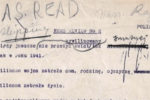
The reproduced image of Beam’s memorandum from a U.S. Embassy cable dated February 19, 1959 illustrates how close Poland came to losing RFE—and how consequential that rejection was.
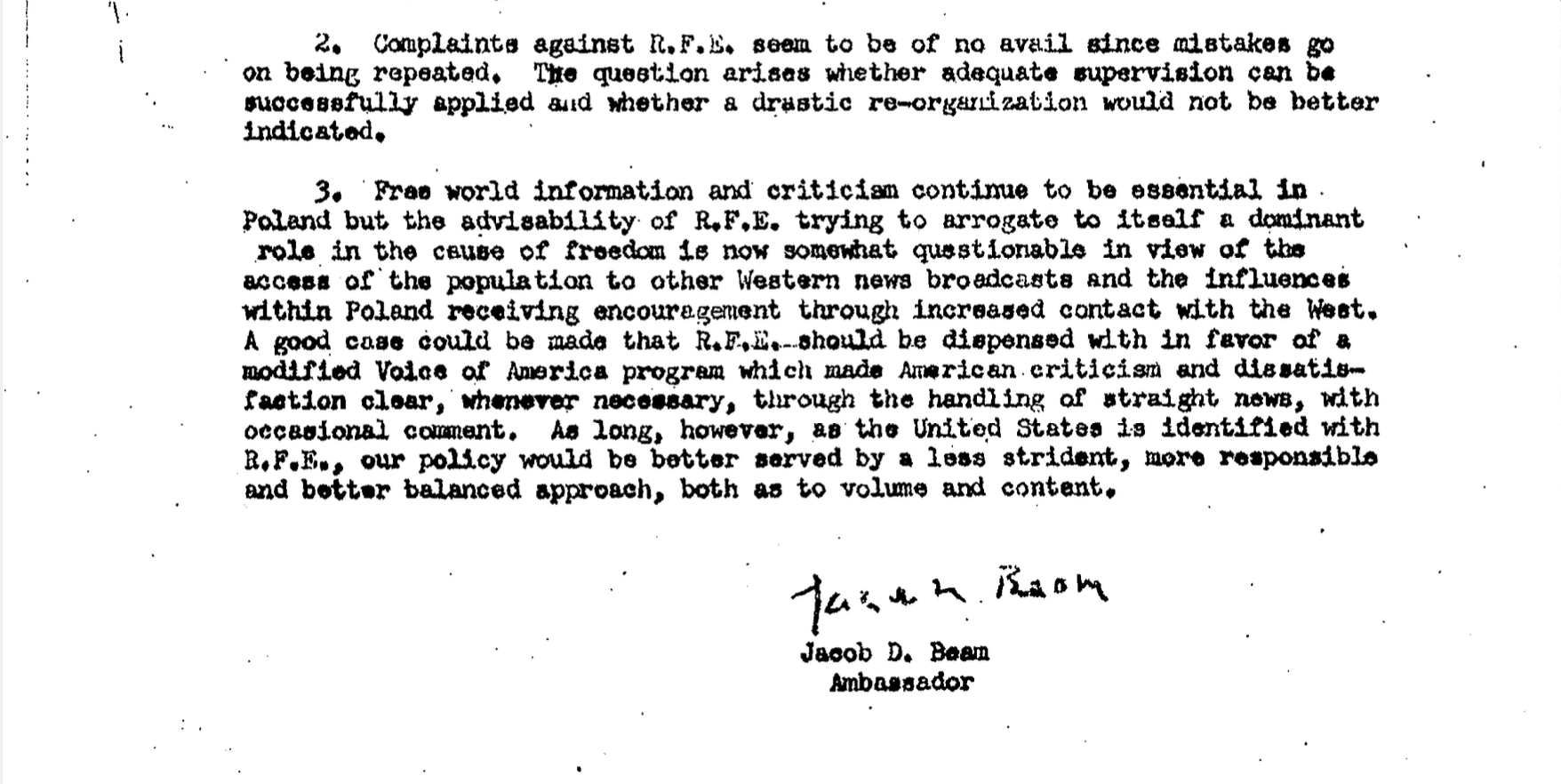
Excerpt from a 1959 U.S. Embassy Warsaw dispatch in which Ambassador Jacob D. Beam argues that Radio Free Europe’s Polish broadcasts should be replaced by a modified Voice of America program. This recommendation was later reviewed and rejected by senior U.S. intelligence officials, who concluded that the embassy’s critique overstated Radio Free Europe’s weaknesses and underestimated its importance as a trusted source of political information inside Poland. The document is reproduced here as a primary source illustrating internal U.S. government debates over Cold War broadcasting strategy and the susceptibility of diplomatic assessments to foreign influence narratives.
See “CIA Rejects Ambassador Beam’s Critique of Radio Free Europe.” Ambassador Beam’s recommendation was later reviewed and rejected by senior U.S. intelligence officials, who concluded that the embassy’s critique overstated Radio Free Europe’s weaknesses and underestimated its importance as a trusted source of political information inside Poland.
Jazz, Public Diplomacy, and Illusions
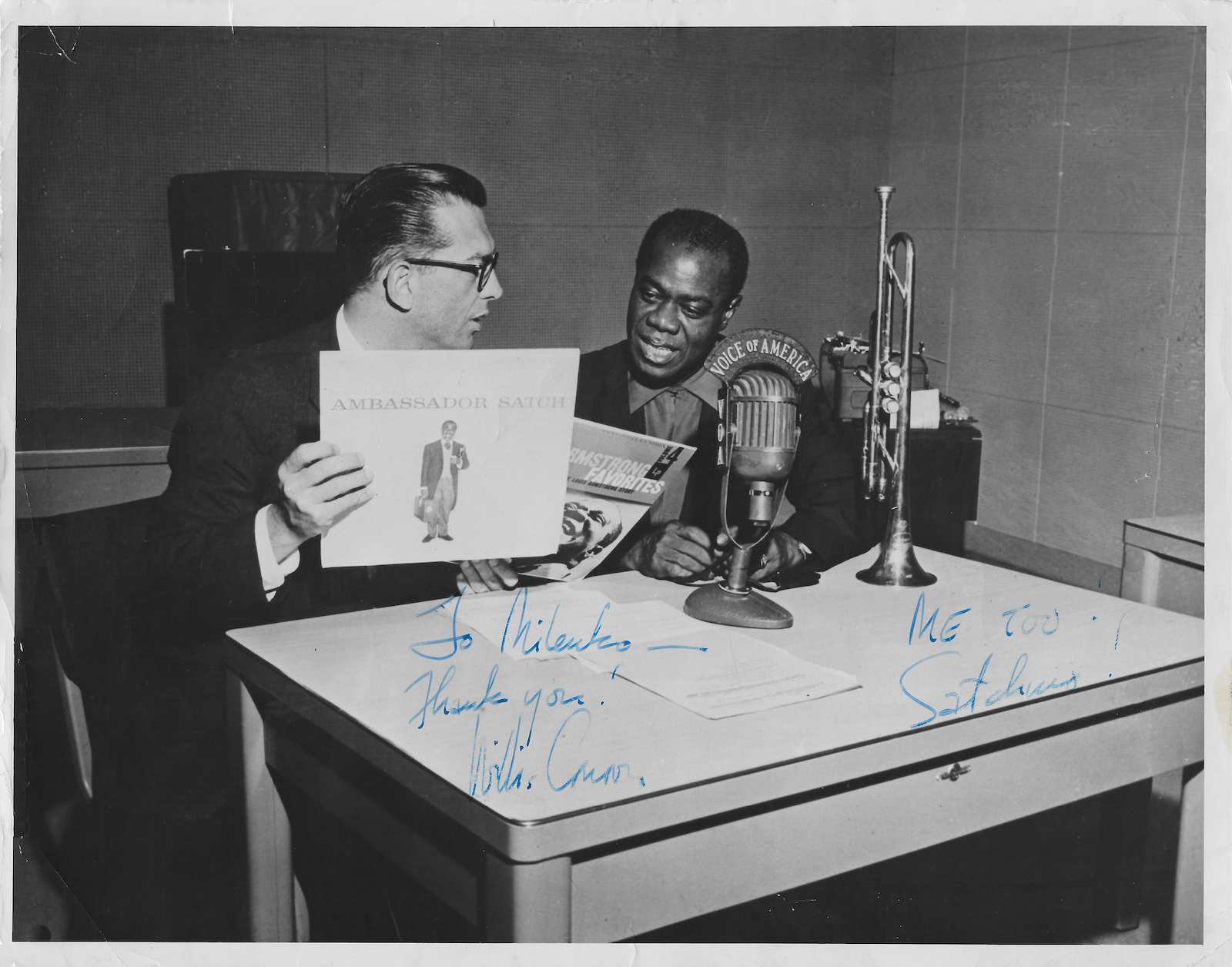
Willis Conover, the legendary jazz broadcaster of the Voice of America, with Louis Armstrong at the VOA studio in Washington, D.C., circa July 13, 1956. The album Ambassador Satch is visible. The original photograph is held in the Cold War Radio Museum archive.
VOA jazz programs hosted by Willis Conover were powerful symbols of freedom, especially in the Soviet Union. In Poland, however, their political impact diminished after 1956, when jazz was no longer banned, and Polish Radio began playing Western music.
Public diplomacy, cultural exchanges, and music mattered, and President Kennedy supported them, as did Edward Murrow at USIA, which administered U.S. government-funded cultural programs in the communist bloc and elsewhere—but they were not substitutes for confronting a fundamentally illegitimate communist system. RFE understood this. It insisted that no amount of cultural openness could replace political truth. Presidents Truman, Eisenhower, and Kennedy agreed. Formerly classified U.S. government documents show how Polish communist influence operations and diplomatic illusions sometimes shaped American debates about broadcasting—an early warning about the effectiveness of foreign disinformation when it aligned with bureaucratic and political interests. Following the example set by the Eisenhower administration, the Kennedy White House also rejected recommendations from some U.S. officials who, in 1961, wanted to restrict Radio Free Europe Polish Service broadcasts.
Murrow, Policy, and Control
Despite his reputation as a symbol of independent journalism, Murrow, as a government official, fully implemented President Kennedy’s policies. During crises such as the Bay of Pigs and the Cuban Missile Crisis, he intervened to ensure that USIA and VOA broadcasts were clear, disciplined, and supportive of U.S. policy—even censoring or rewriting programs when he believed they were insufficiently forceful against Cuba and the Soviet Union.
This historical reality stands in sharp contrast to later myths that Murrow, because of his journalistic background, was opposed to countering Soviet propaganda with VOA broadcasts.
A Note for Polish Readers Today
The 1961 Murrow–RIAS–VOA Christmas broadcast reflects a moment when the United States understood radio as a moral instrument, not a neutral one. It was restrained in tone, but firm in purpose.
In an era when authoritarian regimes once again use propaganda, censorship, and influence operations, the Cold War experience remains relevant. For Poland, the lesson is clear: culture and dialogue matter—but freedom ultimately requires truth spoken without illusion.
That was Radio Free Europe’s role. And that is why these recordings still matter today.
The Berlin Voices: Clips from the Broadcast

Online edition note: This post presents spoken-word excerpts only. Musical performances are omitted (or reduced to a second or two when absolutely necessary for identification) due to rights considerations.
Berlin After August 13, 1961: A City Cut in Two
When the Berlin Wall was erected on August 13, 1961, it transformed daily life overnight — separating families, criminalizing movement, and intensifying surveillance. For many East Germans, radio became one of the last remaining connections to uncensored information and to a wider cultural world. Hearing these voices today, one can almost feel the tension — radio as the only bridge grandparents, spouses, and children could still cross.
What RIAS Was – and Why It Mattered
In the RIAS program itself, the host, Friedrich Luft, describes the station’s purpose in language that still reads like a broadcasting credo: RIAS did not try to dictate opinions, but to represent “different voices” in the democratic world, rejecting propaganda while insisting on truth and cultural freedom. RIAS broadcast excerpt transcript: “We don’t try to tell them what to think… We hate propaganda, but we love the truth…”
We don’t try to tell them what to think. We tell them what the world thinks… We hate propaganda, but we love the truth…10
That statement is not abstract. The program includes letters from listeners behind the Wall describing August 13 as “the blackest day in postwar German history” and calling RIAS “the most effective link between East and West.”
Listener letters excerpt: “Since August 13… you… have become the most effective link between East and West.”11
Murrow’s Presence: From Broadcast Legend to USIA Director
Murrow’s introduction places this Christmas broadcast within a broader U.S. public diplomacy strategy — one that relied less on slogans than on credibility. Murrow/VOA introduction describes RIAS as “a beacon of light” and a symbol of America’s commitment to Berlin.12
Online Audio Excerpts
How to listen: Time references reflect the museum transcript. Murrow–VOA broadcast frames RIAS as a “beacon of light” for listeners living under Communist oppression and introduces Friedrich Luft as host.13
Clip 2 — “We don’t try to tell them what to think…”
🎧 LISTEN FIRST
Friedrich Luft explains RIAS’s editorial philosophy: plural voices, truth over propaganda, culture as freedom. (December 1961).
Clip 3 — Letters from the Other Side of the Wall (spoken)
🎧 LISTEN FIRST
Listener letters describe fear, isolation, and the need to remain anonymous — while identifying RIAS as the essential link between East and West after August 13, 1961. (December 1961).
Clip 4 — Interview: An 18-Year-Old Border Policeman Who Defected
🎧 LISTEN FIRST
A short, restrained exchange with a young guard who crossed into the West — ending with a remarkably humane Christmas greeting to comrades still “standing at the wall.” (December 1961).
Clip 5 — “Music Knows No Boundaries” (U.S. Senator Hugh Scott and greetings from families)
When listening to this recovered Voice of America World-Wide English relay of 1961 segments of RIAS Christmas broadcasts, two moments stand out as a window into the emotional landscape of Berlin only months after the Wall rose.
First, a political voice crosses the divide. U.S. Senator Hugh Scott of Pennsylvania (Republican) speaks directly to East Berlin and East Germany, assuring those behind the “Communist prison wall” that Americans have not forgotten them. His words — “Die Mauer muss weg. The Wall must go.” — frame the broadcast not simply as holiday radio, but as an act of democratic witness from across an international boundary that had become, overnight, a fault-line of global politics.
Immediately afterward, the program pivots from geopolitics to human need. RIAS introduces its Sunday series, “Music Knows No Boundaries,” explaining that it now receives nearly 4,000 letters per month from people separated by the Wall—parents from children, spouses from spouses, grandparents from grandchildren. For listeners who could no longer meet, write freely, or cross the border even at Christmas, radio became what no checkpoint could ever be: a substitute for presence, a conduit of love, a place where words of hope could still travel.
This combination — a U.S. senator’s public vow and ordinary families’ private greetings — captures the broadcast’s full meaning. In 1961, the Wall sharpened and made politics more dangerous. But the voices preserved on this tape remind us that before it was a symbol, it was a wound inside homes and holidays — and radio, at least in moments like these, became the only bridge still standing.
🎧 LISTEN FIRST
U.S. Senator Hugh Scott and family messages across the Wall — East to West, West to East — demonstrating how radio substituted for blocked travel and censored correspondence. (December 1961).
Clip 6 — Willy Brandt’s Christmas Message
🎧 LISTEN FIRST
West Berlin’s governing mayor Willy Brandt describes the Wall cutting “across thousands and millions of families,” and expresses hope for freedom and international understanding in 1962. (December 1961).
Clip 7 — The Freedom Bell & Closing Pledge
🎧 LISTEN FIRST
The broadcast closes with the Freedom Bell’s symbolism and a pledge to resist tyranny — an audio artifact of Berlin’s moral front line. (December 1961).
Transcript: Voice of America – WWEnglish Magnetic Tape – “RIAS Christmas Show” – December 19, 1961 (with Murrow Introduction)
The transcript below is based on a magnetic-tape recording labeled “The Voice of America – WWEnglish – RIAS Christmas Show – 12/19/61 (with Murrow Intro).” The recording contains a spoken introduction attributed to Edward R. Murrow, followed by English-language program segments from RIAS Berlin, interspersed with Christmas music. While joint VOA–RIAS programming of this kind was not routine, this example illustrates moments of cooperation and shared messaging at the height of the Cold War, shortly after the construction of the Berlin Wall.
The tape is housed in a Voice of America box within the Cold War Radio Museum collection. Whether this object represents an original master, a distribution copy, or a later duplication of VOA-originated material cannot be determined. This transcript is provided for research, educational, and documentation purposes. Musical segments and non-verbal audio are marked.
Note: Some musical passages in the original program are omitted or shortened in the online audio edition for rights reasons. Spoken-word content is reproduced here as a primary source transcript.
0:00–0:26 – Station Identification (German)
Speaker 1 • 0:00–0:26
Hier ist RIAS Berlin, eine freie Stimme der freien Welt.
0:27–3:03 – English Identification and Early History of RIAS
Speaker 2 • 0:27–1:03
This is RIAS Berlin, a free voice of the free world. Several times a day, over six million listeners in Communist-controlled East Germany hear this station identification. The initials R-I-A-S stand for Radio in the American Sector. Every day, 24 hours each day, the United States Information Agency’s German language station in Berlin beams its programs over seven medium wave, short wave, long wave, and FM transmitters to the population on the other side of the Berlin Wall.
Speaker 2 • 1:05–1:35
For most of the listeners in the Soviet-occupied zone of Germany, these broadcasts constitute their only link with the free world. The broadcast you’re about to hear will bring you excerpts of actual RIAS Christmas programs. This radio station is unique in the world and in the history of broadcasting. It was founded right after the end of World War II. Soviet troops had seized control of all radio facilities in Berlin, monopolizing the air.
Speaker 2 • 1:35–2:10
Everything they broadcast, news, commentary, reports, radio plays, even music programs, everything reflected the straight Communist Party line. Something had to be done quickly to counteract this propaganda barrage. In March 1946, a radio station was started by the U.S. military government in the American sector of the divided city. News was broadcast as news. Commentaries, reports, lectures brought thought and opinion from the outside world to audiences starved for the truth.
Speaker 2 • 2:10–2:40
A free voice began to ring out 100 miles behind the Iron Curtain. The success of the station was unbelievable. Letters, listener reaction, and encouragement poured in from all parts of Eastern Germany, from Poland, Czechoslovakia, Hungary, from Lithuania and Bulgaria, even from listeners in Moscow. From that day to this, RIAS has continued to be a beacon of light to the millions who, living in the darkness of Communist oppression, listen to it daily.
Speaker 2 • 2:41–3:03
It has become, in the divided city, a symbol of America’s faith in the people of Berlin, an underlining of our guarantee of the independence and welfare of West Berlin. Your host for this broadcast will be one of the many prominent personalities who regularly broadcast over RIAS, the dean of Berlin drama critics, Friedrich Luft.
3:05–6:21 – Friedrich Luft on Culture, Democracy, and Propaganda
Speaker 3 • 3:05–3:47
I, for instance, review plays and new films. That’s all I do, and I do it for 15 minutes every Sunday noon. But I talk about films and plays my listeners in the East will never be allowed to see, plays by Thornton Wilder, by Sartre, by T.S. Eliot, by Dürrenmatt, all French, American, British, Italian, or German films they shall never be allowed to view. Imagine that you were, for what reasons whatever, cut off from the artistic, the cultural, the political, the scientific, or even from the mere entertaining utterances of the more livelier part of this world.
Speaker 3 • 3:47–4:24
You would starve for truth. You would hunger for news. You would thirst for unbiased entertainment. Now, this is just what we from RIAS Berlin have to provide. It is, you might say, an easy job. Perhaps it is. But before all, it’s a good job and a necessary one. Things we in the West have come to take for granted, they are privileges, they are special treats, they are an outlook, and they mean hope for all our million listeners east of the Iron Curtain.
Speaker 3 • 4:24–5:10
We don’t try to tell them what to think. We tell them what the world thinks, and the world, as we know, thinks in many different ways. We don’t try to teach democracy. We try our best to represent the different voices in a democratic world as they are and as they sound. We hate propaganda, but we love the truth and we love the beauty of music and free thinking and drama and science and even jazz, and that we broadcast into what is called the silent zone of Germany as much as we can, as good and honest as we ever can.
Speaker 3 • 5:10–6:00
RIAS is more than a mere radio station. It voices the conscience and thought and happenings of the free world into that part of the world where truth is strangled and beauty is silent and thinking is dangerous. Now, will you listen with me to some items out of our program at this Christmas time? (choir singing) Here, for instance, is the RIAS Chorus, one of the many musical groups connected with this station and known throughout Europe.
Speaker 4 • 6:09–6:21
…and the home of the brave. (singing)
7:09–9:33 – Listener Letters from the Soviet Zone
Speaker 3 • 7:09–7:41
Do letters from the other side of the wall, do listeners’ opinions still reach us? They do. They reach us in hundreds and in thousands, and they show us that thousands and millions rely on this free voice of the free world as their only means of communication with what’s really happening. It’s safe to state that no radio station anywhere is listened to so eagerly. No other station has such a vital following as RIAS.
Speaker 3 • 7:41–7:45
Here are a few excerpts from letters from the Soviet zone.
Speaker 5 • 7:46–7:56
Since August 13, the blackest day in postwar German history, you, dear RIAS, have become the most effective link between East and West.
Speaker 4 • 7:56–8:06
Dear RIAS, we thank you from the bottom of our hearts for your programs which console us in this hour of misery and give us strength to bear our burden.
Speaker 5 • 8:06–8:25
I want to thank you on behalf of many of us who listen regularly to RIAS for your valuable broadcasts, which inform us objectively and give us hope and strength. Since August 13, we have experienced frightful events. We will continue to listen to RIAS because you understand the bitter reality of our lives.
Speaker 4 • 8:25–8:36
Berlin has been closed off and we are now trapped in a concentration camp. We all of East Germany cry out to America and to the Western world, help us.
Speaker 5 • 8:36–8:45
Dear RIAS, we need you. Never forget us. I must remain anonymous. In a free Germany, I could have signed my name.
Speaker 4 • 8:45–8:54
Dear men and women of RIAS, for your objective and always truthful news and commentaries, accept the heartfelt thanks of millions of us.
Speaker 5 • 8:54–9:11
What is happening today in East Berlin and in the Soviet zone is indescribable. There is not only a shortage of food, but also of the everyday things of life. Oppression by the Communist Party bosses is unimaginable. Within this infamous wall, there is only tyranny.
Speaker 4 • 9:11–9:33
Dear RIAS, the deeper one travels in the Soviet zone, the greater becomes your importance. Let me say, strengthen your broadcasts so that they can be heard better in every corner of our prison paradise. Give us the antitoxins to combat the poison of Communist ideology. Thank you, RIAS, for all you have done. Do more.
9:35–11:42 – VOPO Defections and Interview with an 18-Year-Old Border Policeman
Speaker 3 • 9:35–10:02
But letters are not the only means of penetrating the Iron Curtain. More than 100 VOPOs, members of the Communist People’s Police (Volkspolizei), have thrown away their weapons and have come over to this side of the divided city since the wall came up, every time in great danger, every time risking their lives. Here’s one of these refugees in uniform interviewed by a RIAS reporter.
Speaker 4 • 10:15–10:17
You were stationed last at Dreilinden.
Speaker 7 • 10:18–10:22
Yes, in the 11th Company of the 13th Battalion of the Border Police.
Speaker 4 • 10:22–10:29
Christmas is approaching, and as a young man who stood guard at the wall, you must no doubt have wondered how you would have celebrated the Christmas holidays.
Speaker 7 • 10:29–10:43
I can tell you quite honestly, and this is true for everybody, that the morale of the troops will be at the zero point or even worse. There are even cases, and this is no exaggeration, where members of the border police flung themselves on their beds and cried.
Speaker 4 • 10:44–10:47
You don’t appear to be very old. If I may ask, how old are you actually?
Speaker 7 • 10:47–10:48
18 years of age.
Speaker 4 • 10:48–10:52
Just 18. Did you attend school before becoming a border guard?
Speaker 7 • 10:52–10:55
Yes, I graduated in June and I had a job.
Speaker 4 • 10:55–10:57
What did you want to do after graduation?
Speaker 7 • 10:57–10:59
I wanted to study foreign trade.
Speaker 4 • 10:59–11:03
Would you like to send a greeting to your comrades of the border police station at the wall?
Speaker 7 • 11:03–11:19
Yes, I would like to wish all my comrades still standing at the wall at Christmastime to keep their spirits up and not think too much of the events happening at home because this will only depress them more, and perhaps, after all, things may change.
Speaker 3 • 11:21–11:42
Christmas in the East. And here as a matter of contrast, Christmas in West Berlin’s Sportpalast. 8,000 children invited by RIAS to sing together, to hear the Christmas message, and to be merry in a peaceful gathering. 8,000 children singing an old German Christmas carol.
12:32–18:40 – Music, Artists, and Youth Orchestras (Descriptive Narration)
Speaker 3 • 12:32–12:56
Works of great artists are broadcast from this station day after day. Here, you have the voice of one of the greatest singers of the world today, Dietrich Fischer-Dieskau, who, by the way, is a citizen of West Berlin, one of RIAS’s local and most frequent guests.
Speaker 3 • 14:10–14:32
Dance music in modern style is from time to time banned in Eastern Germany. Therefore, the RIAS Dance Orchestra is one of the main temptations, attractions and stimulations especially younger listeners get from this station.
Speaker 3 • 16:12–16:29
And here, our youth orchestra, founded during the blockade, composed of pupils, students, young amateurs from both parts of the city. But now former members of this orchestra in the East can only listen to the music their friends play for them.
Speaker 3 • 18:04–18:08
And this is the Children’s Choir, RIAS …
Speaker 3 • 18:40–19:16
Important visitors from abroad are invited to speak to RIAS listeners in East and West.
19:16–23:41 – Senator Hugh Scott and “Music Knows No Boundaries”
Speaker 3 • 19:16–19:21
This is what Senator Hugh Scott of Pennsylvania said recently.
Speaker 9 • 19:21–20:08
I want to extend my heartfelt Christmas greetings to the people of East Germany and East Berlin over RIAS, the free voice of the free world, in Berlin. As a member of the United States Senate, I want to assure all those Germans who live now on the other side of the Communist prison wall that Americans have not forgotten them, and that we hope that the Christmas message may help them to carry the heavy burden, and to realize that in the United States, as in Germany, we feel too that the time must come when Die Mauer muss weg.
Speaker 3 • 20:08–20:38
Die Mauer muss weg. The wall must go. This wall has led to a special program broadcast every Sunday for 90 minutes. It is called Music Knows No Boundaries. Here listeners in the West can send musical greetings to their relatives, their friends and acquaintances they are no longer allowed to meet or speak to in person. The popularity of this program is at the same time touching and pathetic.
Speaker 3 • 20:38–20:52
Nearly 4,000 letters asking us to send musical greetings to their loved ones in the East reach us every month. The program runs as follows. (instrumental music plays)
Speaker 10 • 21:13–21:48
Dear listeners, here again, as on every Sunday, is Regina Pfeiffer, bringing you greetings from West to East and from East to West. Because it is Christmastime, RIAS has been asked much more than usual to transmit family greetings. And so, Annie and Herbert from Tegel send all their love to their mother at Pankow in East Berlin.
Speaker 10 • 21:48–22:23
Deep affection and love to Grandpa and Grandma at Treptow in East Berlin, from their children, Margot, Ernst and Bodo at West Berlin, Bamberger Strasse. Here’s a letter from Australia. Wolfgang, Ruth, Michael and Peter, living at Siemer, send all their love to their parents and grandparents in East Berlin. A lonely mother at Potsdam greets with all her heart her children, Wolfgang and Nanny and little Sabina in West Berlin.
Speaker 10 • 22:23–23:00
Best Christmas wishes for Rolf and Bern, and especially for my dearest husband, Erich, in West Berlin, from Gila and her mother at Pankow, East Berlin. Dear Erich, for 12 years, this is the first Christmas Eve we have to celebrate alone, separated by the wall. Continue to keep up your courage. And here again is a letter from overseas, this time from Battle Creek, Michigan in the USA, sent by Anna, Martha, Gertrude and Franz.
Speaker 10 • 23:00–23:38
Best wishes and love to all their family members, three families in all, at Frankfurt (Oder), East Germany. Frau Vera in West Berlin sends all her love to her blind father at Jena, East Germany. Hans and Betty at Hanover send their kindest remembrances and best Christmas wishes to Mother and Dad at Magdeburg, East Germany. And now a song requested by those parents and children, relatives and friends in East and West, Freiheit, die ich meine.
Speaker 10 • 23:38–23:41
Freedom Which I Think Of. (instrumental music plays)
24:41–26:15 – Willy Brandt’s Christmas Message
Speaker 3 • 24:41–24:47
And here, ladies and gentlemen, the governing mayor of Berlin, Willy Brandt.
Speaker 1 • 24:47–25:21
Ladies and gentlemen, I’m very glad I have this opportunity to say a word to the friends of Berlin all over the world. This has been a difficult year for Berlin. And, uh, in August this year, a terrible wall has been established which not only goes across a city, but also goes across thousands and millions of families.
Speaker 1 • 25:22–26:02
This has been a year full of dangers for freedom and world peace. I hope that 1962 will be a good year for freedom, justice, and international understanding, and by that, for my city of Berlin. May I, ladies and gentlemen, express my gratitude and that of my fellow Berliners for all of the expressions of understanding, sympathy and support which we have been privileged to receive.
Speaker 1 • 26:02–26:15
All my good wishes are with you. May I wish you, may I wish all of you, a merry Christmas and a happy New Year.
26:25–27:57 – The Freedom Bell and Closing Pledge
Speaker 3 • 26:25–26:59
This is the Freedom Bell, ringing from the West Berlin City Hall, gift of the American people to Berlin, heard every day at noon in East and West. And no wall, no fortification, no Iron Curtain can silence the message inscribed on this bell, which has become, since 1950, a true symbol of this gallant city.
Speaker 3 • 27:00–27:05
Speaker 2 • 27:05–27:57
I believe in the sacredness and dignity of the individual. I believe that all men derive the right of freedom equally from God. I pledge to resist aggression and tyranny wherever they appear on Earth.
NOTES:
- Orson Welles and John Houseman reportedly caused panic in much of the United States with their 1938 Mercury Theatre on the Air production of H. G. Wells’ The War of the Worlds, which mixed genuinely sounding but fake evening radio news bulletins with dramatic descriptions of an alien invasion.
- See Under Secretary of State Sumner Welles’s 1943 memorandum. State – Welles, Sumner, 1943-1944, From Collection: FDR-FDRPSF Departmental Correspondence, Series: Departmental Correspondence, 1933 – 1945 Collection: President’s Secretary’s File (Franklin D. Roosevelt administration), 1933 – 1945, National Archives Identifier: 16619284.
- Owen Lattimore, “New Road to Asia,” National Geographic, December 1944, p. 567.
- Julius Epstein, “The O.W.I. and the Voice of America,” reprint from the Polish American Journal, Scranton, Pennsylvania, 1952.
- Julius Epstein, “The O.W.I. and the Voice of America,” reprint from the Polish American Journal, Scranton, Pennsylvania, 1952.
- Arthur Krock, “President Rebukes OWI for Broadcast on Regime in Italy,” The New York Times, July 28, 1943, A5.
- Robert William Pirsein, The Voice of America: An History of the International Broadcasting Activities of the United States Government, 1940–1962 (New York: Arno Press, 1979), 112.
- Puddington, Broadcasting Freedom, 125–126; Yale Richmond, “Nixon in Warsaw,” American Diplomacy, November 2010
- PAP and Polskie Radio 24.pl, “‘Gazeta Polska’: matka Rafała Trzaskowskiego była tajnym współpracownikiem bezpieki o pseudonimie Justyna,” September 5, 2018.
- RIAS Christmas program (VOA World-Wide English recording).
- Ibid.
- Ibid.
- Ibid. Transcript: “A free voice began to ring out…”